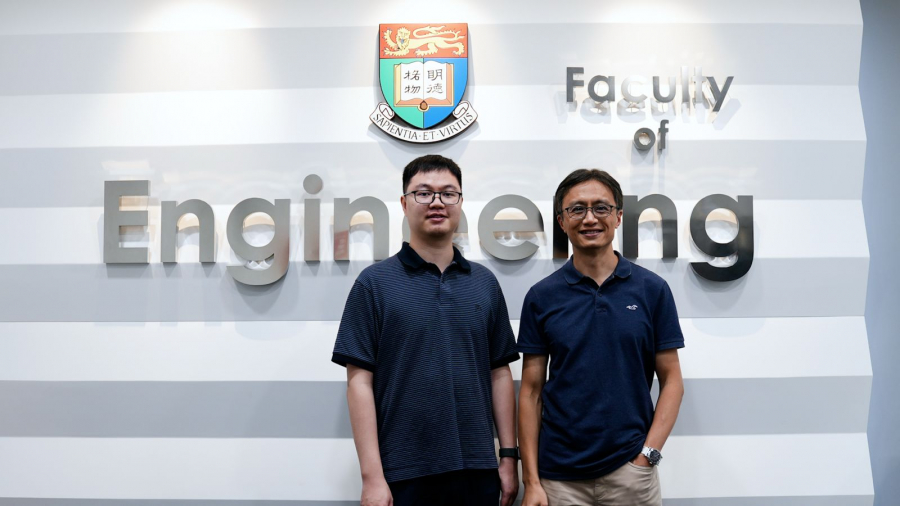
A cross-institutional research team led by Professor Ngai Wong and Dr Zhengwu Liu from the Department of Electrical and Computer Engineering in the Faculty of Engineering at The University of Hong Kong's (HKU), in collaboration with Tsinghua University and the Southern University of Science and Technology, has developed Co-Located Authentication and Processing (CLAP), a revolutionary privacy-preserving system that overcomes the trade-off between security and performance in edge computing devices.
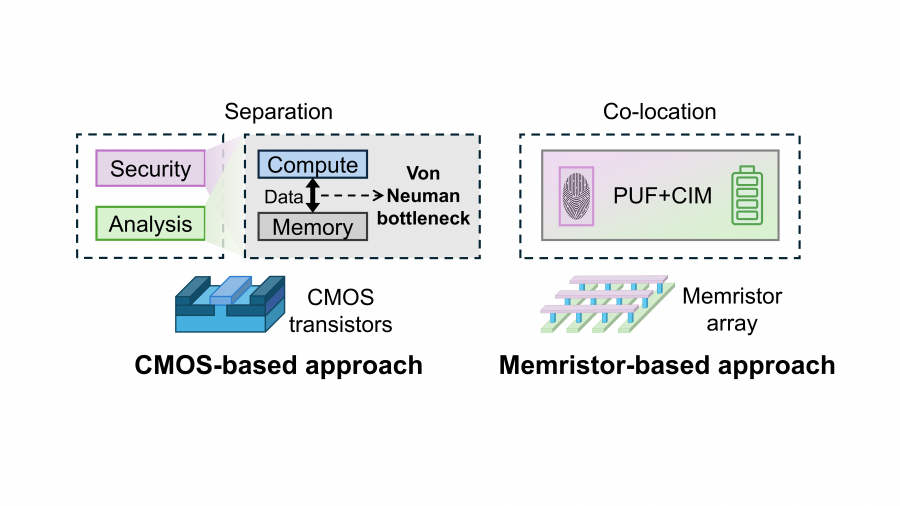
The CLAP system integrates authentication and processing functions within a unified memristor-based platform, offering critical security protection for applications ranging from wearable medical devices to industrial IoT. This innovation addresses major vulnerabilities in current edge computing systems.
Edge computing devices—from wearable health monitors to industrial sensors—face a critical security challenge: how to protect sensitive data while maintaining efficient on-device processing. Recent incidents have demonstrated how attackers could remotely manipulate insulin pump dosages or exploit vulnerabilities in hundreds of thousands of cardiac devices, highlighting the urgent need for intrinsically secure solutions in resource-constrained scenarios where every milliwatt of power and square millimeter of silicon matters.
The key innovation lies in memristors—emerging electronic components that store data and perform calculations in the same location, unlike conventional computers where memory and processing are separated. Beyond this compute-in-memory advantage, memristors also possess inherent physical randomness—tiny, unavoidable variations between individual devices. This randomness serves as a unique security identifier for device authentication while the compute-in-memory capability enables efficient data analysis.
Dr Liu explained, "We exploit both characteristics simultaneously. Current solutions separate security from analysis modules and memory from computation units, creating significant hardware and energy overheads—prohibitive for resource-limited edge applications. Our hardware-level integration maintains authentication reliability and computational accuracy without traditional inefficiencies."
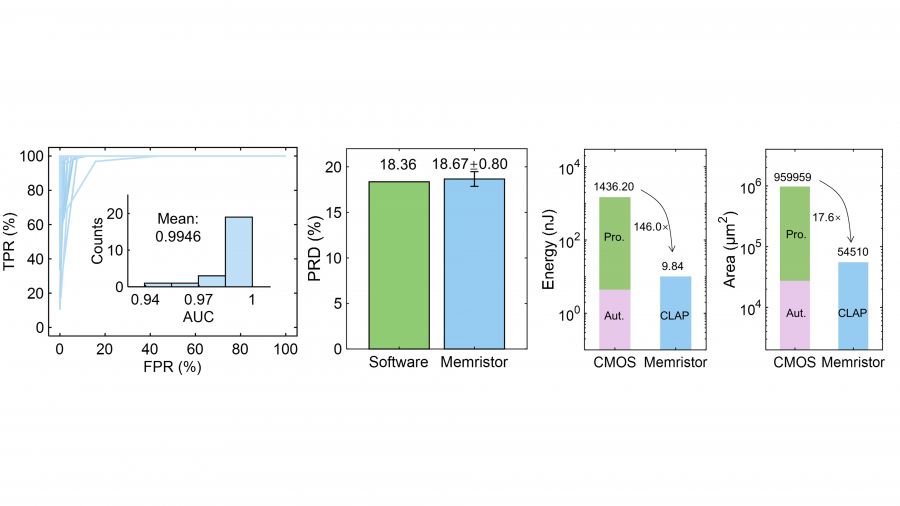
The team demonstrated CLAP’s versatility in diverse information processing tasks, including discrete wavelet transform, discrete Fourier transform, compressed sensing, and multi-layer perceptron neural networks. As a proof-of-concept, the researchers showcased secure electrocardiogram (ECG) data collection in healthcare monitoring, achieving device authentication with an area under the curve of 99.46% and efficient signal compression with 18.67% percentage root-mean-squared difference. The results are remarkable, 146-fold energy efficiency gain and nearly 18-fold area reduction compared to conventional implementations.
"This technology represents a significant milestone in secure edge computing," noted Professor Wong. "These improvements are critical for any resource-constrained application, from medical implants to industrial IoT sensors. We’re moving toward a future where security is not an add-on module but an intrinsic property of the computing hardware itself."
The project received support from the National Natural Science Foundation of China, the Theme-based Research Scheme and the General Research Fund from the Research Grants Council of Hong Kong SAR, the AVNET-HKU Emerging Microelectronics and Ubiquitous Systems (EMUS) Lab, and ACCESS – AI Chip Center for Emerging Smart Systems, supported by the InnoHK initiative of the Innovation and Technology Commission. The research team includes Professor Ngai Wong, Dr Zhengwu Liu and Mr Chenchen Ding from HKU; Professor Huaqiang Wu, Dr Bohan Lin, Professor Jianshi Tang, and Professor Bin Gao from Tsinghua University; Professor Zhongrui Wang from the Southern University of Science and Technology.
The study, titled "Privacy-preserving data analysis using a memristor chip with co-located authentication and processing," was published in Science Advances.
Link to the paper: https://www.science.org/doi/10.1126/sciadv.ady5485
About Professor Ngai Wong
Professor Ngai Wong received the B.Eng. and Ph.D. degrees in electrical and electronic engineering from HKU. He was a Visiting Scholar with Purdue University, West Lafayette, IN, USA, in 2003. He is currently an Associate Professor with the Department of Electrical and Computer Engineering, HKU. He is the Director of the AVNET-HKU Emerging Microelectronics & Ubiquitous Systems (EMUS) Lab launched in 2025. His research interests include compact neural network design, compute-in-memory (CIM) AI chips, electronic design automation (EDA) and tensor algebra. He also serves as the project coordinator of a 5-year Hong Kong Theme-based Research Scheme (TRS) titled “ReRACE: ReRAM AI Chips on the Edge" (2022-2027) that promotes next-gen neuromorphic AI computing and applications.
About Dr Zhengwu Liu
Dr Zhengwu Liu is currently a Research Assistant Professor with the Department of Electrical and Computer Engineering, HKU. He received his B.E. degree from the University of Electronic Science and Technology of China and his Ph.D. degree from Tsinghua University. His research interests include memristor-based neuromorphic computing, compute-in-memory chips, and brain-computer interfaces (BCIs). He has published in Nature Electronics, Nature Communications and Science Advances. His work was featured by Nature News and selected as one of the 2025 China Top 10 Semiconductor Research Achievements. He is also a recipient of the Rising Star Award, HUANAO China BCI Prize.
Media Enquiries
Faculty of Engineering, HKU
Ms Christina Chung (Tel: 3910 3324; Email: chungmc@hku.hk)
Ms Natalie Yuen (Tel: 3917 1924; Email: natyuen@hku.hk)

 Facebook
  HKU IOS App
  HKU Android App
  Social Media and Apps